

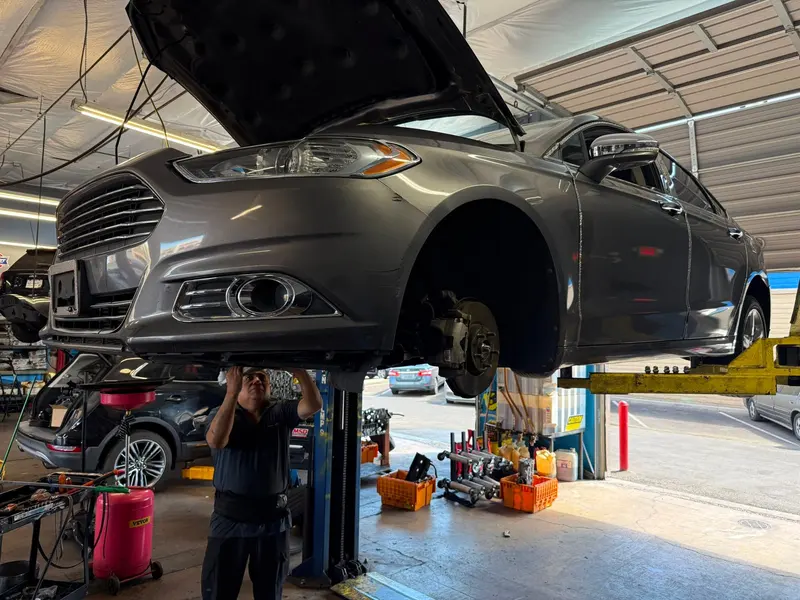
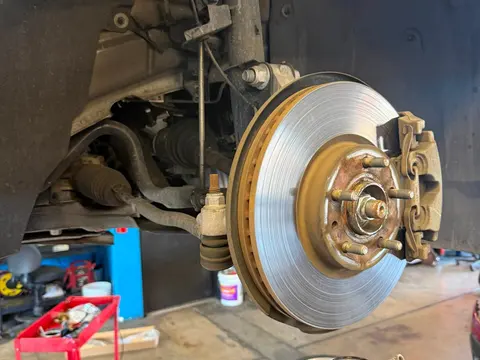
A 2013 Ford Fusion at our shop at 3560 E Tropicana Ave in Las Vegas, in for lower control arm replacement. Here is what the customer told us, what we found and what we did.
Customer Concern
The Fusion needed suspension repair.
Diagnosis
Our suspension inspection found the lower control arms needed replacing.
Repair Performed
Lower control arms replaced.
About This Repair
The lower control arm connects the wheel assembly to the car's frame and lets the suspension move up and down. Worn bushings or ball joints in the arm can cause clunks over bumps, wandering steering and uneven tyre wear. Replacing the arm replaces those wear points too.
Signs a 2013 Ford Fusion Needs Lower Control Arm Replacement
On a 2013 Ford Fusion, a worn lower control arm usually announces itself gradually. Many drivers first notice a dull clunk or knock from the front end when driving over speed bumps, driveway lips or rough pavement. You might also feel a shimmy or vibration through the steering wheel that gets worse on uneven roads. Braking can reveal the problem too, with the car pulling left or right or the front end feeling like it shifts forward before settling. Some owners describe the steering as vague or loose, needing small corrections to stay centered in the lane. Take a look at the front tires as well, since wear on the inner or outer edges can point to a suspension part that is no longer holding the wheel at the correct angle. Any of these signs is worth having checked, because they can also overlap with other front-end problems.
What Causes Lower Control Arm Wear on a Ford Fusion
Lower control arms take a beating every time the wheel moves, so wear is a normal part of a car's life. The rubber bushings that cushion the arm where it mounts to the subframe slowly harden, crack and tear with age. In Las Vegas, long stretches of desert heat can speed up that process, since high temperatures dry out rubber and make it lose its flexibility. The ball joint at the outer end of the arm is sealed by a rubber boot, and once that boot splits, dust and grit can get inside and wear the joint faster. Impacts also play a role. Hitting a deep pothole, sliding into a curb or driving over road debris can bend an arm or loosen a joint suddenly. Heavy loads and frequent rough roads add stress over time, which is why these parts eventually need attention even on a well-kept car.
What to Do When Your Fusion's Front End Clunks or Wanders
If your Fusion starts making new noises over bumps or the steering no longer feels steady, it is best not to wait for the problem to settle on its own. Suspension wear tends to get worse over time, and a loose control arm can speed up wear on tires, tie rod ends and other front-end parts. Pay attention to when the symptoms happen, such as while turning, braking or crossing rough pavement, because those details help narrow down the cause. Avoid hard braking and aggressive driving until the car has been looked at, and steer clear of potholes where you can. Bring it in so the cause can be diagnosed, since clunks and wandering can also come from sway bar links, struts or steering components. After control arms are replaced, a wheel alignment is generally recommended so the tires track straight and wear evenly.