

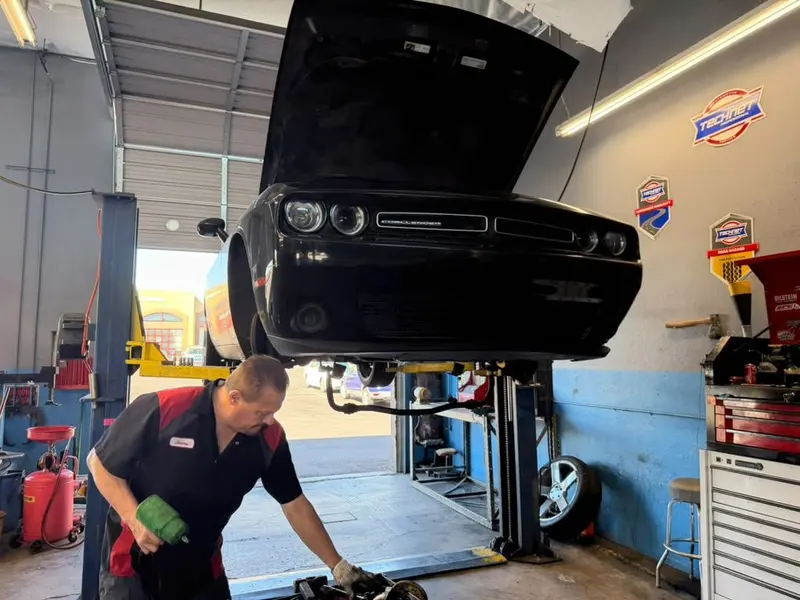
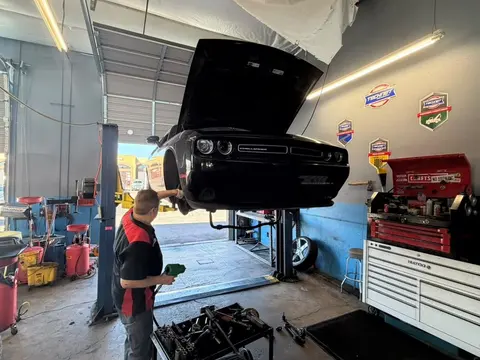
A 2016 Dodge Challenger at our shop at 3560 E Tropicana Ave in Las Vegas, in for lower control arm service. Here is what the customer told us, what we found and what we did.
Repair Performed
Lower control arm work on the front suspension.
About This Repair
Control arms carry the wheel and keep it lined up as the suspension moves. On a heavy, powerful car like the Challenger, their bushings and ball joints take a lot of load. Worn ones show up as clunks, loose steering or tyres wearing on one edge.
Signs a 2016 Dodge Challenger Needs Lower Control Arm Service
The most common sign is a clunk or knock from the front end when you go over bumps, dips or driveway edges, or when you brake hard and the nose dips. Some drivers notice the steering feels vague or wanders on the highway, so the car needs small corrections to stay straight. You may also feel a shimmy through the steering wheel, especially while braking, as a worn bushing lets the arm shift. Uneven tire wear is another clue, often showing up as wear on the inner or outer edge of a front tire. On a car with wide, performance-oriented tires like many Challengers, that wear can be easy to miss until a tire is badly scuffed. If you hear a creak or squeak when turning at low speed, a dry or failing ball joint could be the source.
What Causes Lower Control Arm Wear on a Challenger
Lower control arms on the Challenger handle a lot of force. The car is large and heavy, and many versions put out serious power, so every launch, hard stop and quick turn pushes and pulls on the arm bushings and ball joint. Over time the rubber in the bushings softens, cracks or tears, and the ball joint wears loose inside its socket. Potholes, curbs and rough parking lot entrances speed this up by sending sharp impacts through the arm. In Las Vegas, desert heat adds another layer. Long stretches of high temperatures can dry out rubber bushings and boots, and once a ball joint boot splits, dust and grit get inside and wear the joint faster. Lowered suspensions, oversized wheels and spirited driving can also add stress. Sometimes an arm is simply bent from an impact rather than worn.
What to Do When Your Challenger's Front End Starts Clunking
Pay attention to when the noise or looseness happens, such as over bumps, during braking or while turning, because that detail helps narrow down the cause. Clunks in the front end can also come from sway bar links, tie rod ends, strut mounts or other parts, so it is worth having the suspension checked rather than guessing. Bring it in so the cause can be diagnosed with the car lifted and the parts inspected for play. Try not to put it off. A badly worn ball joint can separate, which can cause a loss of steering control, and loose arms will keep chewing through tires. After control arm work, a wheel alignment is usually recommended, since replacing these parts can change the angles that keep the car tracking straight and the tires wearing evenly.