

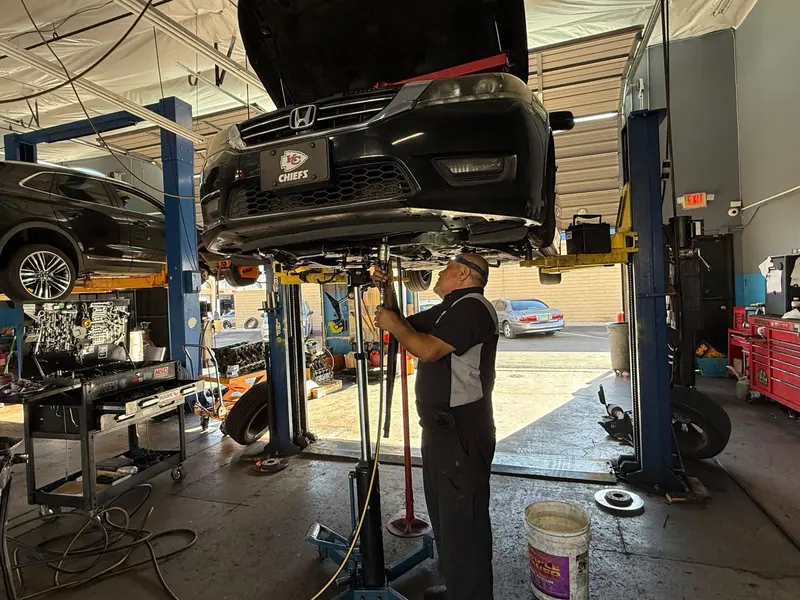
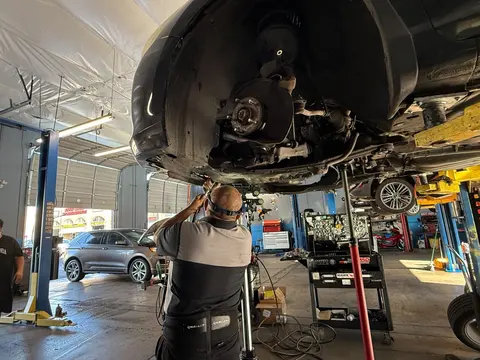
A Honda Accord at our shop at 3560 E Tropicana Ave in Las Vegas, in for transmission replacement. Here is what the customer told us, what we found and what we did.
Customer Concern
The transmission was not shifting properly.
Diagnosis
Our diagnosis found the transmission itself had failed.
Repair Performed
Transmission replaced.
About This Repair
Shifting problems do not always mean a failed transmission. Fluid, sensors, solenoids and the electronic controls can all cause them. That is why we diagnose first. In this Accord's case the fault was inside the transmission, so replacement was the repair.
Signs a Honda Accord Needs Transmission Replacement
A failing transmission in a Honda Accord usually gives warning signs before it stops working altogether. Harsh or delayed shifts are common, where the car hesitates before engaging Drive or Reverse, or bangs into gear with a noticeable jolt. Some drivers notice the engine revving higher than normal while the car struggles to pick up speed, which is often described as slipping. Others feel shuddering at low speeds, hear whining or grinding noises, or find the car stuck in one gear. A check engine light or transmission warning may appear, and you might smell a burnt odor or spot reddish fluid under the car. Any of these symptoms can point to internal wear, but several of them can also come from simpler problems. That overlap is why a proper diagnosis matters before anyone decides the transmission has to be replaced.
What Causes an Accord Transmission to Fail
Transmissions rely on clean fluid at the right level to lubricate, cool and transmit hydraulic pressure. When fluid runs low, breaks down or becomes contaminated, clutches, bands, bearings and other internal parts wear faster. Heat is one of the biggest enemies of transmission fluid, and the long stretches of desert heat in Las Vegas put extra stress on any automatic. Stop-and-go traffic, towing, carrying heavy loads and idling in traffic with the air conditioning running all add to that heat. Over time, worn friction material can leave debris in the fluid that clogs passages and affects shifting. Skipped fluid service, leaks that go unnoticed and driving on with early symptoms can let a small problem grow. Eventually internal damage reaches a point where repairing individual parts is no longer practical, and replacing the transmission becomes the sensible option.
What to Do When Your Accord Starts Shifting Poorly
If your Accord begins shifting roughly, slipping or hesitating, it is wise to address it soon rather than waiting. Start by noting when the problem happens, such as when the car is cold, after a long drive, at certain speeds or only in reverse. Those details help a technician narrow down the cause. If your Accord has a fluid dipstick and you can check it safely, look for a low level, a dark color or a burnt smell, but avoid simply topping off and ignoring the symptom. Try to limit hard acceleration and heavy loads until the car is inspected, since continuing to drive on a slipping transmission can turn a repairable issue into a full failure. If warning lights come on or the car will not move in gear, it is safer to have it towed. Bring it in so the cause can be diagnosed and the right repair can be chosen.